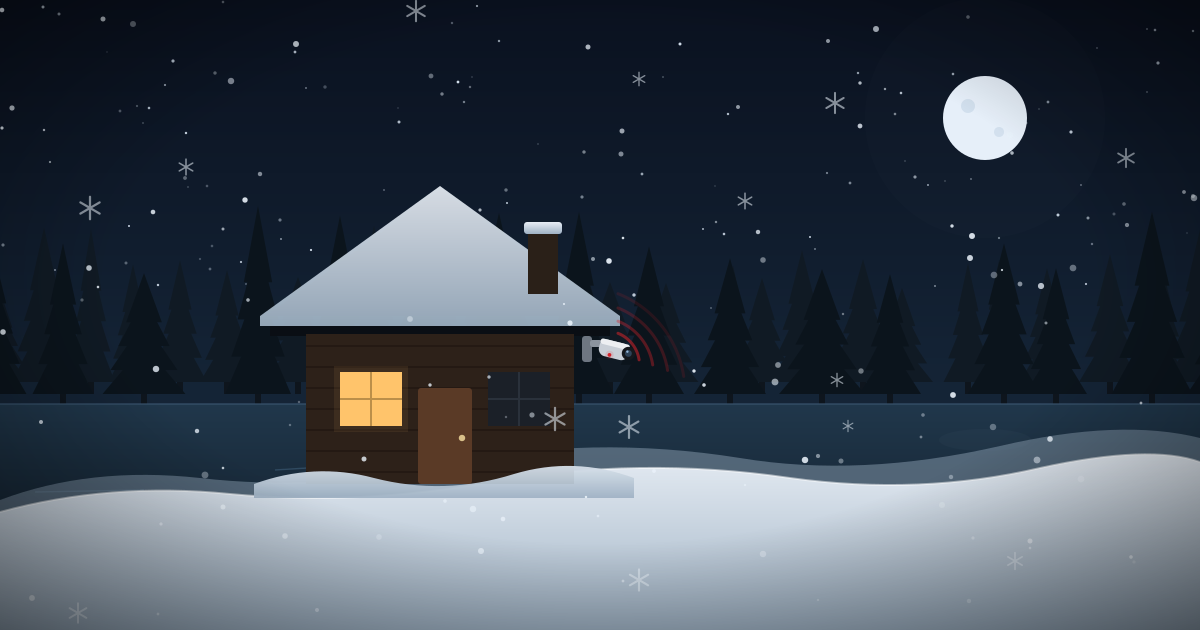
A cottage spends most of the year doing something a house never does: sitting completely empty, at the end of a road nobody drives in winter, with no neighbours close enough to notice anything. From the October long weekend to the May one, most Ontario cottages are visited a handful of times, if that.
That changes what you are protecting against. The risk is not somebody kicking a door in while you sleep upstairs. The risk is a problem that starts in November and is still going in April.
What actually happens to empty cottages
Two things, in this order of expense.
Water. Far and away the biggest loss. A line that was not fully drained lets go in January, and the water runs until someone shows up. We have seen cottages where the damage was measured in months rather than litres. Nothing on a property gets destroyed faster than a building that freezes, thaws, and freezes again with water moving through it.
Theft, and it is rarely the TV. What goes missing from cottages tends to be whatever can be carried or towed: tools, generators, chainsaws, outboard motors, ATVs, snowmobiles, boats and trailers, fuel, and increasingly copper and wiring. Much of it goes from the boathouse, the shed or the driveway rather than the cottage itself, which is why protecting only the front door misses the point.
There is a third category worth naming. Cottages get used. Doors get opened by people who want somewhere warm for a weekend, and the damage from that is often worse than anything they take.
Before you lock up in October
Do the water shutdown properly, then monitor it anyway
Drain the lines, blow them out, shut the main, and add antifreeze to the traps. Then put a monitored freeze sensor inside and a water sensor at the low point. The shutdown is what prevents the damage. The sensors are what tell you the shutdown did not work, while there is still something to save. If the cottage is heated through the winter, this matters even more, because a furnace that quits in a building nobody visits is the exact scenario that produces a total loss.
Photograph everything and write down serial numbers
Walk through with your phone before you leave. Every room, the shed, the boathouse, the contents of the garage. Serial numbers on the outboard, the generator, the sled, the tools. This takes fifteen minutes and is the difference between an insurance claim that gets paid at value and one that gets argued about.
Make the place look attended
Arrange for the driveway to be plowed even if nobody is coming, and have someone drive in occasionally. Tracks in the snow and a cleared entrance say the property is being watched. An unbroken bank of snow across the driveway from December to March says the opposite, loudly, to anyone driving by.
Do not announce the vacancy
A social post about closing up for the season is read by more people than you think. Neither is a note on the door for a contractor a good idea. If a trade needs access over the winter, give them a code you can cancel afterwards rather than a key under the step.
The system that suits a property nobody visits
Monitoring is the whole point
A siren at a cottage in February is a sound nobody hears. The only version of this that works is a system connected to an accredited monitoring station, so that a sensor tripping in the middle of the night reaches an actual person who calls it in. Without monitoring you are not protecting the cottage, you are collecting evidence for the spring.
Assume the internet will fail, because it will
Cottage internet drops. Power goes out in ice storms and comes back days later. A system that only reports over Wi-Fi is offline exactly when you need it. Cellular communication with a battery backup keeps the panel reporting through a power cut, and cameras that record locally to a recorder keep capturing even while the connection is down, so the footage is there when service returns.
Cover the way in, not just the door
On most cottage properties the access point that matters is the driveway or the water. A camera at the entrance that captures vehicles and plates is worth more than three cameras on the cottage itself. Add a driveway sensor and you know the moment anything turns in, which on a property with a long approach is a genuine head start.
Protect the outbuildings, because that is where the value sits
The boathouse, the shed and the garage often hold more replaceable value than the cottage's contents. Door contacts and a motion sensor in each, tied to the same monitored system, cost very little to add while a technician is already on site.
Be able to look, from home
The practical benefit cottage owners talk about most is simply being able to open an app in February, see the place standing there with snow on the roof and no water running, and go back to what they were doing. That peace of mind is worth more than most of the hardware.
What this typically costs
A monitored alarm with cellular reporting, contacts on the main doors, a motion sensor, and freeze and water detection is the core package, and it lands in the same range as a modest home system. Cameras at the entrance and on the outbuildings are the usual addition. Most cottages are done in a day, though the drive time means we like to group work by region.
Monitoring fees run monthly, and many insurers discount seasonal property premiums for monitored alarm and fire systems, which offsets part of it. Ask your broker what they recognize before you decide on the configuration, and see our guide on monitored alarms and home insurance in Ontario.
We already drive these roads
Ranger covers Grey and Bruce, Kawartha Lakes, Simcoe County, Huron and Perth and the rest of southwestern and central Ontario, which is to say most of where Ontario keeps its cottages. If you are closing up this fall, the time to have someone look at it is before the water goes off, not after the first freeze.
More on how we approach seasonal and second properties on our cottage and vacation home page.
Common questions
Do I need internet at the cottage for a security system?
No. A monitored alarm panel can report over the cellular network, which is more reliable than cottage internet and keeps working during a power outage when paired with a battery backup. Cameras can record locally to a recorder and upload footage when a connection is available.
What is the biggest risk to a cottage over the winter?
Water damage from frozen and burst pipes, not theft. A proper water shutdown prevents it, and monitored freeze and water sensors alert you if the shutdown fails or the heat quits while nobody is there.
Can a security system protect a boathouse or shed as well as the cottage?
Yes. Door contacts and motion sensors in outbuildings tie into the same monitored system as the main building, which matters because tools, outboards, generators and recreational vehicles are the items most often stolen from seasonal properties.
Does a monitored alarm lower insurance on a seasonal property?
Many Canadian insurers offer premium discounts for professionally monitored alarm and fire systems, and seasonal properties are often eligible. Ask your broker exactly what they recognize before choosing the configuration, and request a monitoring certificate once the system is installed.
Quotes and site visits are always free, and always pressure-free.
Get a free quote